
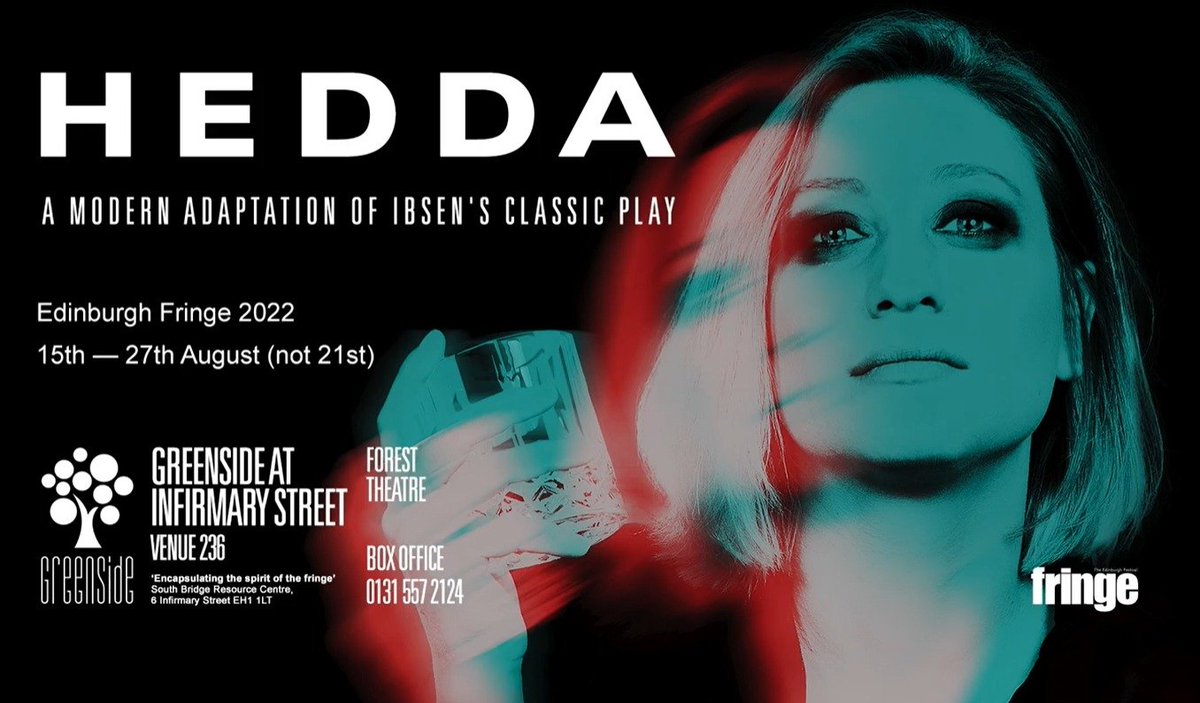
Wonderlabs’ reinvention of Henrik Ibsen’s classic play ‘Hedda Gabler’ is exactly what you’d hope for upon hearing that the story and its characters are to be modernised for the telling of this tale. Dafna Rubinstein has introduced modern audiences into the world of technology; male dominated, and cocaine driven. The essence of Hedda Gabler is truly as alive as it has ever been, as we see her egotistical and traumatised personality. Running till the 27th of August (except from the 21st) at Greenside’s Infirmary St venue.
Many will know the story of ‘Hedda Gabler’, a strong and fiercely independent woman who knows how to act as is expected of her for the sake of society but deep down she is bored of what life has to offer her and as a result, toys with the lives of those around her for entertainment. At the beginning of the play, she is newly married to Tesman, who is awaiting to hear about his future career, one which will finance Hedda’s life when her old school mate Thea appears and announce the return of Hedda’s secret ex-lover, Lovborg. From this moment Hedda uses her self-awareness as a beautiful woman to entice the men into doing as she pleases without even knowing so. Lovborg and Tesman are originally both academics of history and are competing for the same job. However, this has cleverly been adapted in reimagining this story being told for the 21st century, and both are now technology experts in coding databases, and Lovborg’s manuscript was not burnt in the fireplace, but rather the device containing his programming was broken in a blender. Another important change from the script would be the open use of narcotics which aid the character’s immoral behaviour.
Noa Har-Zion embodies the wonderfully antagonistic Hedda. From the moment she walks on the stage we understand her body language and relationship with her husband as she swaggers around with unfiltered confidence, doing as she please at everyone’s expense. The audience love to hate her, exactly as Ibsen had intended in his original play, creating a character who could never morally fit in with society. Har-Zion’s movement beautifully allows the audience to see a version of Hedda that she keeps hidden from the public, exploring the mess inside her own mind that drives her to be the manipulative and self-destructive person she has become. By intercepting dialogues with movement, the actress creates a more personal connection with the audience and that is what allows them to find themselves feeling sympathy for such a mean-spirited character.
Tesman, played by Iftach Ophir, is Hedda’s new husband, a much kinder soul and a very innocent man, believing he could be the one to hold down the one and only Hedda Gabler. Ophir’s portrayal of Tesman serves as a wonderful juxtaposition to Hedda, exhibiting the balance (or lack thereof) in their marriage as he tries his very best to please her with gifts. Throughout the story we see his character breakdown as obstacles are put in place that prevent him from having the life he has always wanted, including Hedda’s ex lover. Whilst Ophir’s version of Tesman is much more assertive than the original character, it is a necessary change in order for the story to be told in such a fantastic way after its modernisation. From the moment he arrives on stage the audience fall in love with this handsome, yet slightly awkward version of Tesman.
Benny Elder as Lovborg is a commendable casting choice. Lovborg is a character from Hedda’s past that ignites a passion she has never shown for her husband, nor the other men in her life. Upon his return he has a woman, a career and a life to be jealous of. The way in which Elder play the nonchalant character with ease whilst managing to serve as the catalyst for destruction throughout the play is nothing short of magnificent. Throughout the story we see how his old habits return upon meeting with Hedda, and how this deeply effects everyone around him. His storyline is especially tragic as he is easily influenced by others, returning to his old ways and leaving behind those to grieve for him, including the audience thanks to Benny Elder’s performance.
Sharon Burstein Bichachi as Thea was slightly lacklustre, leaving the audience wanting more. Thea is a kind woman, a friend of Hedda’s from school and Lovborg’s current lover but as is such in the original script, she is not up to the same standard as the other characters. She is not aware of when she is being lied to, or how to get what she wants in the same way the others do, creating a sense of apathy when the other character produce a such strong emotional response from the audience. Whilst Bichachi’s performance alone was not particularly below standard, as she presented a weak character, one who does not like to take up much space or time, it would have been nice to see the character be slightly reinvented for a modern audience, an audience who long to see even the weakest of characters displayed on stage with such intensity, much like Ophir’s Tesman.
Finally, Ben Perry as Brack provided this infamously dark play with equally dark humour to match it. Far from the older, powerful judge that Ibsen had intended him to be, Perry’s version illustrates the issue of men who abuse their power over women. He is a sleazy coke head, and possibly the only person who truly understands Hedda’s psyche, making him an awfully conflicting character, wherein the audience are so confused about how they should feel about them. Perry’s display of desire for Hedda airs the sexual tension that the play needed for today’s audience and keeps the audience on tenterhooks until the moment the lights go out.
Dafna Rubinstein has commendably adapted ‘Hedda Gabler’ for the stage whilst including the fundamental elements of the original story, maintaining Ibsen’s voice throughout. Her decision as director to include elements of choreographed, stylised movement is what has allowed the audience to connect on an emotional level with Hedda, something which many adaptations struggle with in making the play suitable for modern audiences.
Dafna Peretz’ design work should also be noted as an enhancement to the story. There was enough set to make the stage look like a home but not too much that it clouded the actors’ performances. The colour of the drinks and the couch and the footstool ,which were used by all the characters, stood out in such a subtle way. And the way the stage was used to portray the timeline, with the room getting messier and messier with more drugs and alcohol and people being introduced. What was once a lovely, new home for a newly married couple had become the scene of Hedda’s crimes and gave us an insight to Hedda’s mind.
This story is a fine example of how classic plays can be developed for the stage in 2022 whilst simultaneously restoring the integrity of its original playwright. As an avid fan of Ibsen’s work I am glad to say that ‘Hedda’ exceeded my expectations and should be proud of it efforts in recreating this infamous story.
Get your tickets for ‘Hedda’ below:
 Theatre Scotland
Leave a comment