
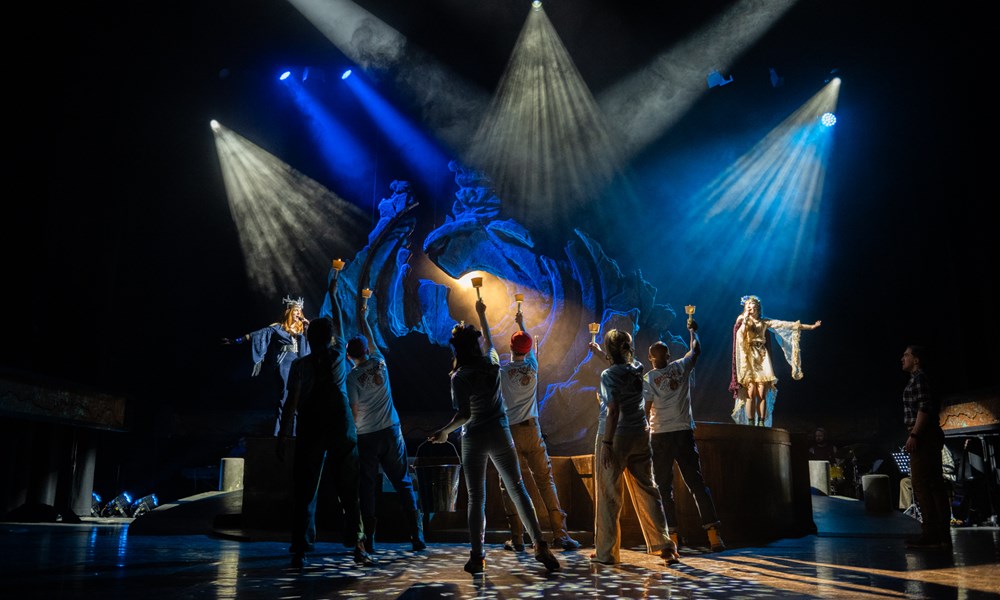
All I knew about “Stamping Ground” going in was that it was set in the highlands and that it was a Runrig jukebox musical. Having not delved into the long and weathered discography of the Scottish musical legends myself, I recognised nothing other than “Loch Lomond” amid their Spotify top 5 most streamed songs, meaning all of the other 21 songs featured in the production where fresh and new for me.
A couple originally from Glenbeag in the Scottish Highlands return there from London after their daughter is horrifically bullied by her so-called friends. With outside investors vying to buy up land to turn into holiday homes for tourists, a small group of locals are battling to save their local pub. As heavy baggage from the past, and secrets that will threaten to tear the group apart start to surface, they must find a way to navigate it all and save the place they all call home.
Ali Watt does well as Euan. Euan is the father running from London back home to his mother to help “save” his daughter Fiona. Watt is held down by playing a character that is cursed with being one-note throughout the story; refusing to see reason and letting his emotions blind him to what’s staring him in the face. With that said, Watt does his best to bring something to that limited arc and makes the audience understand, as much as they can, what’s going on in his head. Bringing some genuinely emotional moments and a beautiful singing voice, Watt manages to carry the play on his shoulders even if he gets weighed down a little by the writing.
Jenny Hulse is Annie. Hulse has a great voice and uses it often in the show. Her character has some of the most emotional realisation throughout the story, meaning that after almost every time her character Annie speaks, the audience knows she will break off into song as she does it so often. That said, Hulse handles each song brilliantly and makes “all things must change” a truly moving moment. She is believable as a younger mum to Fiona and a woman who is yearning to explore herself and what she could be, rather than what she feels she has to be, bringing the audience along for every step of the ride.
Naomi Stirrat is excellent as Summer. A humble tour guide, yet Summer is the heart of the story and that is in huge part to Stirrat’s performance. She is subtle yet in-your-face, gentle yet fierce and a joy to watch and listen to on stage. Another fantastic singer; she brings tears to the auditorium with her stirring rendition of “And We’ll Sing”.
Caitlin Forbes is great as Fiona. She plays a 16-year-old teenager convincingly while managing to avoid being annoying or whiny. Her performance is strong and nuanced while being large enough to convince a full auditorium that she is a child. Her violin/fiddle playing throughout is a very nice touch, also highlighting the talent on display from Forbes.
Annie Grace plays Euan’s Mother. Grace does well with this part and has a lovely singing voice. Her character has some moments that almost feels like she throws things away that seemed rather important but this is probably down to writing/direction. Grace glues the group together with her portrayal of *Mother* and is a comforting presence on stage.
Juliet Cadzow is fantastic. Her character is really just there to deliver jokes and punchlines. She is the older, alcohol-loving, flirty woman-at-the-bar stereotype but plays it well, while getting the laughs along the way, even if she does occasionally stray into delivering her lines as if expecting to get a laugh. Robert Grose is Johnny. Grose is given the challenge of playing a character thrust upon the audience very suddenly who is simultaneously a love interest and an antagonist that isn’t written well as either. Grose does what he can but the character just feels weird and out of place almost all the time, waltzing into stage in a kilt for no reason was the immediate first and final straw.
Rohin Campbell does very well as the regular at the bar. He is funny, compelling and endearing. Little hints to his character are well portrayed and give the audience lots of information in short amounts of time. Brian James O’Sulivan is great as the Barman. He has the responsibility of rallying the troops while also being a constant source of support and optimism. Campbell and O’Sulivan together bring some of the biggest laughs of the show and it all feels incredibly natural and shows the connection the two have on stage.
Barrie Hunter, Jon Mackenzie and Stuart Semple are all fantastic musicians within the band. Semple ventures onto stage to gleefully play the spoons or tap away at a bodhrán are very fun and don’t happen nearly enough. And Hunter does excellently in his shorter role as Donny, the elder of the village who loves a pint and a little dance with the younger Summer. His song in act 1 is a genuine highlight of the show. Provoking real emotion while keeping the singing simple yet beautiful and feels like a real song you’d see and old geezer singing down the pub while reminiscing on life. While also playing bass through the rest of the show Hunter’s talent and impact on the production is truly commendable.
Movement Director Jade Adamson, and assistant Alexandra Harrington, do well with this production to get the cast moving in a uniform, big and energetic way. The cast is rather small so can occasionally feel like the movement lacks energy due to this. However, the choreography in the dancing sections feels slightly basic and lacks a certain punch. This could be a decision made to make it feel more down to earth, and more rural or grounded but it just meant for some lackluster dance breakouts to some very upbeat music.
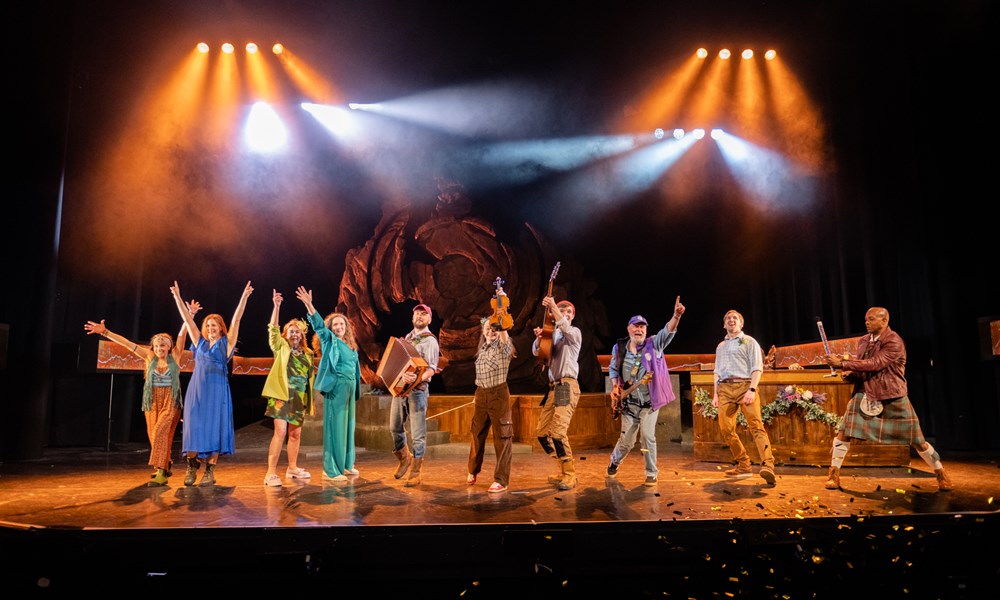
Luke Kernaghan does well in the Director’s chair. The show starts out with a couple of very intriguing and eye-catching sequences, with choreography that does stand out, and some fantastic lighting and music stabs to go along with it all, making it feel like it may be leaning towards a physical theatre piece. But these ideas quickly fizzle out and it seems like a few ideas where had but not deeply explored. Kenneth MacLeod’s staging is nice, yet again rather basic, and maybe could have done with a few more design pieces to make it feel less like a fringe show, using as little staging as possible; all moveable by a small number of actors. Simple staging can be effective, when done properly.
Overall, this show is a bit rushed and not as tight as it could have been in terms of production value. It seems to rely too heavily on the Jukebox Musical formula; as the characters can feel archetypal at times and certain scenes are shoe-horned and rushed in to make way for the next of 20+ songs. This wasn’t helped by sound issues which made the singing hard to hear, very often it felt like things were being lost and songs that are beloved by many weren’t getting the treatment they deserve. The band, and all live musicians on stage, were excellent and it was a lovely touch having the band on stage, feeling like part of the storytelling, with actor-musicians building upon this concept. The finale of the show is the highlight, with huge energy and some large payoffs in the story, it brings a smile to everyone watching, and finally giving the audience, who have been itching to sing along the whole time (they didn’t they were VERY well behaved) something to sing to at the very end by inviting them on their feet to sing Loch Lomond together is a fantastic touch of Scottishness to bring together a thoroughly Scottish evening of Scottish musical entertainment.
Get your tickets for ‘The Stamping Ground’ below:
https://www.capitaltheatres.com/whats-on/all-shows/the-stamping-ground/2087
 Theatre Scotland
Leave a comment