
Few productions leave audiences as in awe as An Inspector Calls, and this latest UK tour is no exception. Produced by PW Productions, one of the most prolific and significant theatre producers, founded by the late Peter Wilson MBE, this revival of Stephen Daldry’s iconic staging is as gripping as ever. With its ingenious set design, looming lighting, and a cast that keeps you glued to your seat, J.B. Priestley’s classic thriller remains a theatrical masterpiece.
But what makes this production truly chilling is its continued relevance, its sharp critique of social responsibility and inequality feels just as urgent in today’s political climate as it did when it was first written. This isn’t just a play; it’s a wake-up call. Prepare to be captivated, unsettled, and completely absorbed in a theatrical experience that lingers long after the curtain falls.

Tim Treloar delivers a magnetic performance as the enigmatic Inspector Goole, commanding the stage with a quiet intensity that never wavers. He pulls information from each of the Birling family members like teeth, relentless yet measured, ensuring the tension never breaks. His presence is unwavering, holding the audience in the palm of his hand as he steers the plot of this morality play with precision. A fantastic driving force behind the production, Treloar ensures that every revelation lands with weight, leaving the audience hanging on his every word.
Jackie Morrison delivers a brilliantly snobbish and utterly detestable portrayal of Sybil Birling, embodying upper-class superiority with every calculated movement and icy remark. She oozes entitlement, holding her head high above the likes of the Inspector, even above her own children, with a self-assuredness that is as infuriating as it is captivating. Her dismissive attitude toward the working class is stomach-churning, making her eventual revelation all the more satisfying to watch. Morrison makes Mrs. Birling intensely proper and formally cut-throat, ensuring that every sharp-tongued denial and indignant protest only deepens the audience’s frustration with her.

Loud and self-important, Jeffrey Harmer delivers a loathsome portrayal of Arthur Birling, perfectly capturing the character’s pompous arrogance. He strides across the stage with an air of untouchable authority, convinced he is above the law and beyond reproach. His reluctance to come down from his perch – the elevated house set piece- to meet the Inspector at the start of the play speaks volumes about his character, a man who believes himself superior to those beneath him. Harmer and Morrison play off each other brilliantly, their Birling marriage steeped in self-importance and willful ignorance, reinforcing their shared belief that wealth and status shield them from consequence. A thoroughly detestable performance in all the right ways.
Tom Chapman conveys a compelling performance as Gerald Croft, balancing charm with a deep-seated reluctance to accept true responsibility. His monologue is absolutely gripping, drawing the audience into his confession with a sincerity that almost makes you sympathize, until his privilege and self-interest creep back in. Watching him work through his own story is beautiful, his emotions shifting as he relives his past with Daisy Renton. However, any sense of redemption is swiftly undercut by his determination to deny the Inspector’s authority, clinging to the hope that this interrogation is nothing more than a trick. Chapman expertly captures Gerald’s internal conflict, making him one of the production’s most fascinatingly flawed characters.

Leona Allen’s portrayal of Sheila Birling is a striking transformation, as her initially bratty nature quickly shifts to one of guilt and self-awareness as she grasps the gravity of the Inspector’s visit. Her wide-eyed realization of her own privilege and responsibility makes her one of the most compelling characters to watch. Her reactions to the family’s confessions are utterly captivating, offering a stark contrast to their stubborn denial. Her interactions with Chapman’s Gerald are especially gripping – she practically becomes an extension of the Inspector, coaxing the truth from him with a mix of hurt and determination. Allen ensures that Sheila’s arc is one of genuine change, making her one of the production’s most engaging performances.
George Rowlands undergoes a remarkable transformation in his portrayal of Eric Birling, initially appearing as an excitable lap dog desperate to entertain his father and future brother-in-law. Rowlands slinks away into the shadows only to return with a bang, revealing a disheveled and remorseful Eric that starkly contrasts with the naïve boy we first meet. His manic monologue is one of the production’s most compelling moments. As Eric’s guilt spills over, his panic erupts with a shattering decanter, an explosive release of emotion that underscores his internal collapse. Rowlands captures the raw vulnerability and chaos of Eric’s remorse, making his character’s journey both heart-wrenching and unforgettable.
This being Alice Darling’s first UK tour, she’s made it an unforgettable one with her portrayal of Edna. Rarely leaving the stage, she remains a silent witness to the unfolding mystery, subtly representing the working class from her shadowed, upstage position, only appearing to serve the Birling family and their guests. Her quiet presence is loud in this production, and as the Birlings lament their privileged lives, I found myself drawn to her. Darling’s understated performance almost becomes a reflection of Eva Smith herself – silent but omnipresent, quietly bearing the weight of the family’s actions in a way that speaks volumes without uttering a word.
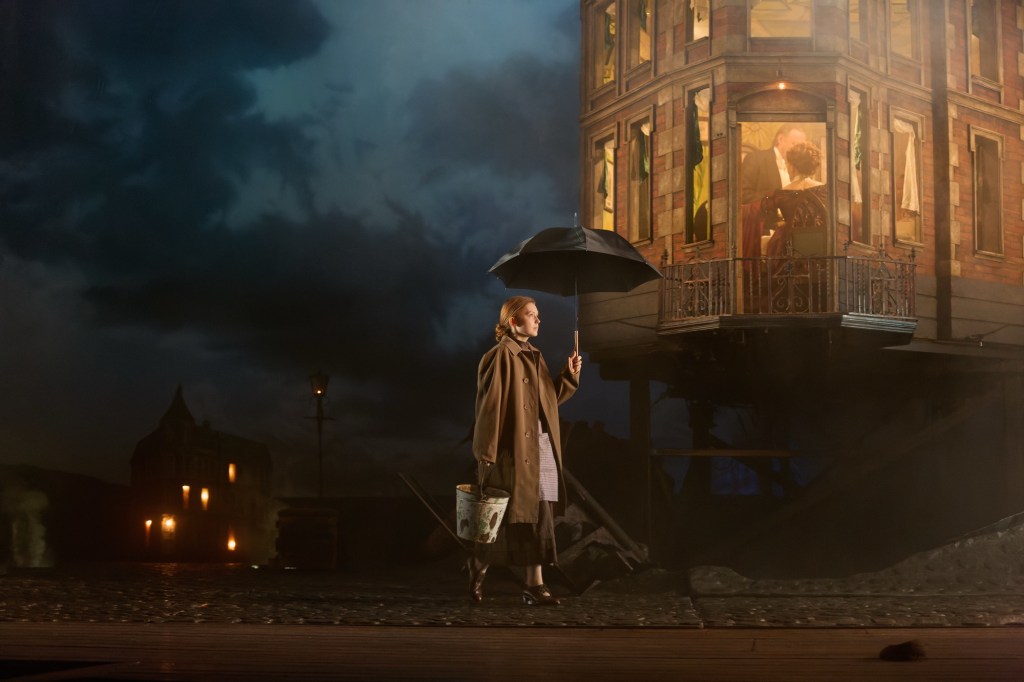
Opening the show by emerging through the audience and playing in the rain, Ramsay Kidd portrays the Younger Boy. Much like Darling’s Edna, Kidd’s character acts as a silent observer, a shadow to the Inspector as he watches the mystery unfold. His presence feels symbolic, perhaps representing the next generation, silently watching as the older generation falters – will he learn from their mistakes? This subtle yet powerful role adds an additional layer to the production, reminding us of the importance of the lessons passed down to future generations.
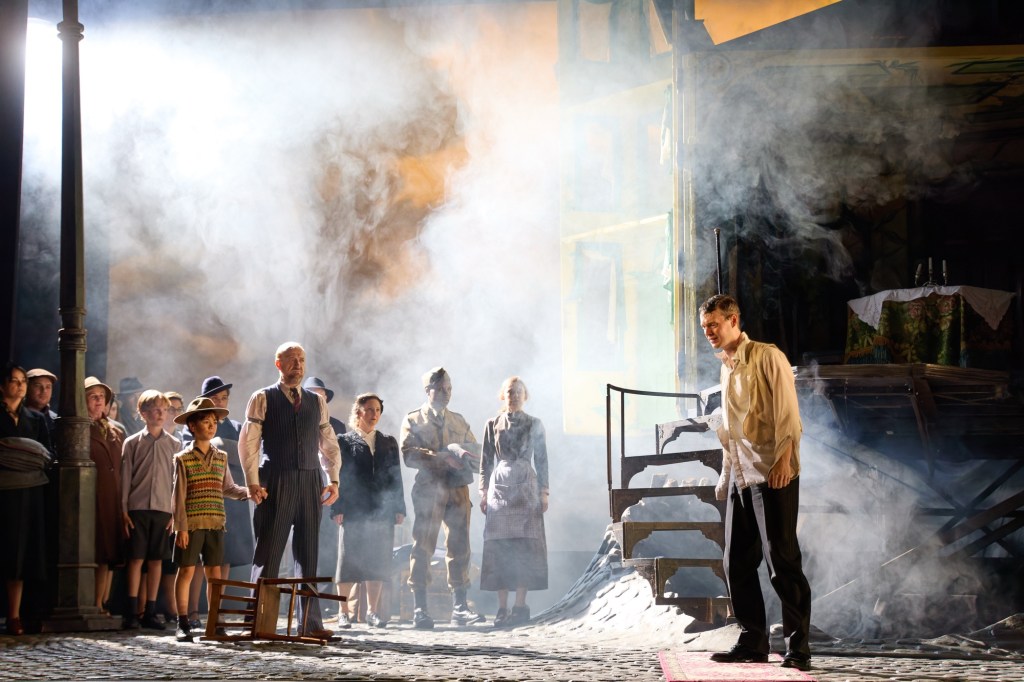
PW Productions called on local talent to volunteer as walk-on community members, and their contribution adds a powerful layer to the production. Nearing the end, the ensemble makes a striking entrance, revealed in a dramatic burst of light, like a tablecloth being yanked away, to stand upstage, glaring down at the Birling family. This moment is chilling, as they represent the collective public judgment, a silent but damning reminder of the weight of the Inspector’s visit. Their presence serves as a striking visual cue, emphasizing the moral reckoning the characters face, and reinforcing the play’s themes of social responsibility and consequence. The ensemble are as follows; Jack Varley, Mia Macpherson, Lorna Cassie, Victoria Chanter, Calum Cormack, Kathleen A. Duguid, Marianna Houdijk, Selina Kotan-Mehmet, Joyce Lettis and Chris Walter.
With 4 Olivier Awards and 10 Tony Awards, it’s not surprising that this astounding production is directed by the highly decorated Stephen Daldry. His direction brings a perfect balance of intensity and subtlety to An Inspector Calls, masterfully handling the pacing to keep the tension simmering just beneath the surface. Daldry brilliantly draws out the darkly prophetic nature of Priestley’s script, making the characters’ moral failings painfully apparent while keeping the audience on the edge of their seats. He also orchestrates the transitions between moments of investigation and revelation with seamless precision, blending them into the heart-stopping climax. Daldry’s work ensures that An Inspector Calls Remains as relevant, gripping, and thought-provoking as ever.
Ian MacNeil’s set design is nothing short of breathtaking, with the iconic house suspended above the action, physically demonstrating the upper and lower classes’ divide. This towering structure reflects the Birlings’ illusion of security and privilege, suspended high above the moral reckoning unfolding below. A striking feature of MacNeil’s design is the rain that pours down onstage, an unexpected yet impactful element that underscores the tension and the sense of impending doom. This dramatic touch not only heightens the atmosphere but also mirrors the emotional turmoil within the characters. The fluidity of the set allows the production to flow effortlessly, with moments of surprise and tension emerging as the house and its surroundings shift. MacNeil’s design is a vital player in this production, amplifying the tension and heightening the sense of unease.
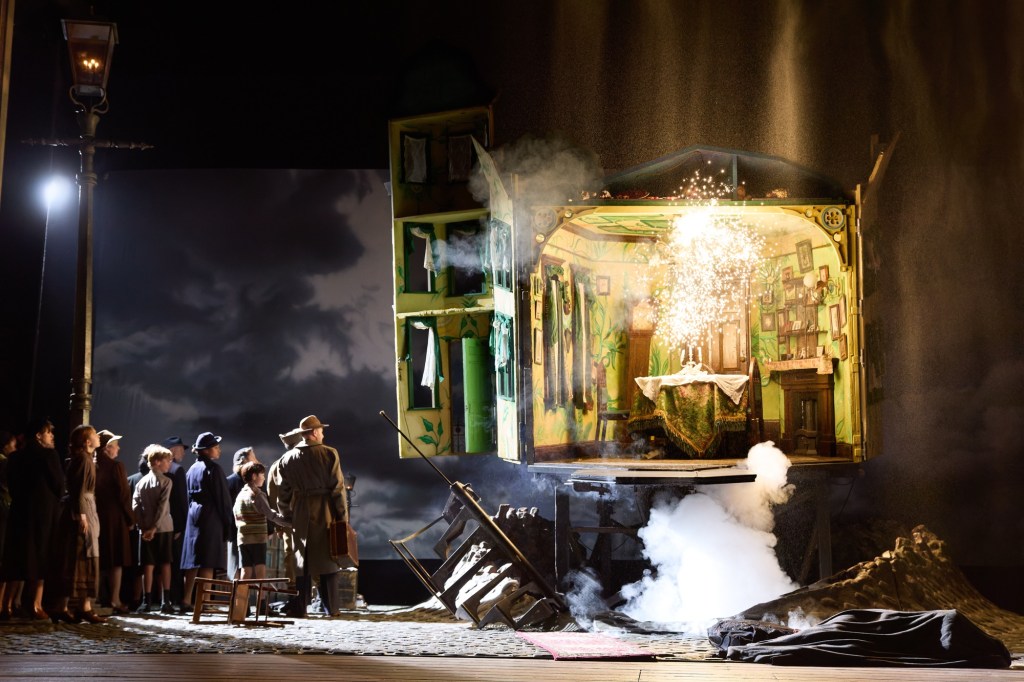
Ricky Fisher’s lighting design is integral to the atmosphere of An Inspector Calls, using stark spotlights and looming shadows to create a sense of unease and tension. The sharp contrasts between light and dark reflect the moral divides within the play, with moments of revelation highlighted by sudden bursts of light. Fisher’s design not only enhances the suspense but also adds a haunting quality to the production.
Sebastian Frost’s subtle yet unsettling sound design amplifys the tension, with ambient noises like the creaking of the house and distant, rumbling thunder adding to the sense of mounting dread. While Stephen Warbeck’s haunting, minimalist score complements this, with the music swaying between dramatic and mournful, intensifying key moments of the production. Together, their contributions create an immersive sensory experience that draws the audience in from the rise of the curtain.

An Inspector Calls is a thrilling, thought-provoking production that leaves a lasting impact on its audience. With a talented cast, led by the commanding presence of Tim Treloar as the Inspector, and a creative team that has expertly crafted an atmospheric, visually striking world, this is a production that not only captivates but challenges. The intricate set design, stunning lighting, and powerful sound design work in perfect harmony to heighten the tension and underscore the play’s timeless relevance. Directed with precision by Stephen Daldry, this is a must-see production that leaves you questioning your own moral compass long after the final curtain falls. It’s truly heartbreaking that a play written in 1945 still has such devastating relevance 80 years later. You cannot deny the timelessness of J.B. Priestley’s morality thriller, and this production, unlike the Birling family, is faultless in every aspect. Don’t miss the chance to experience this gripping, unforgettable production.
‘An Inspector Calls’ running from the 26-29th March at His Majesty’s Theatre.
Get your tickets here: https://www.aberdeenperformingarts.com/whats-on/an-inspector-calls/
 Theatre Scotland
Leave a comment