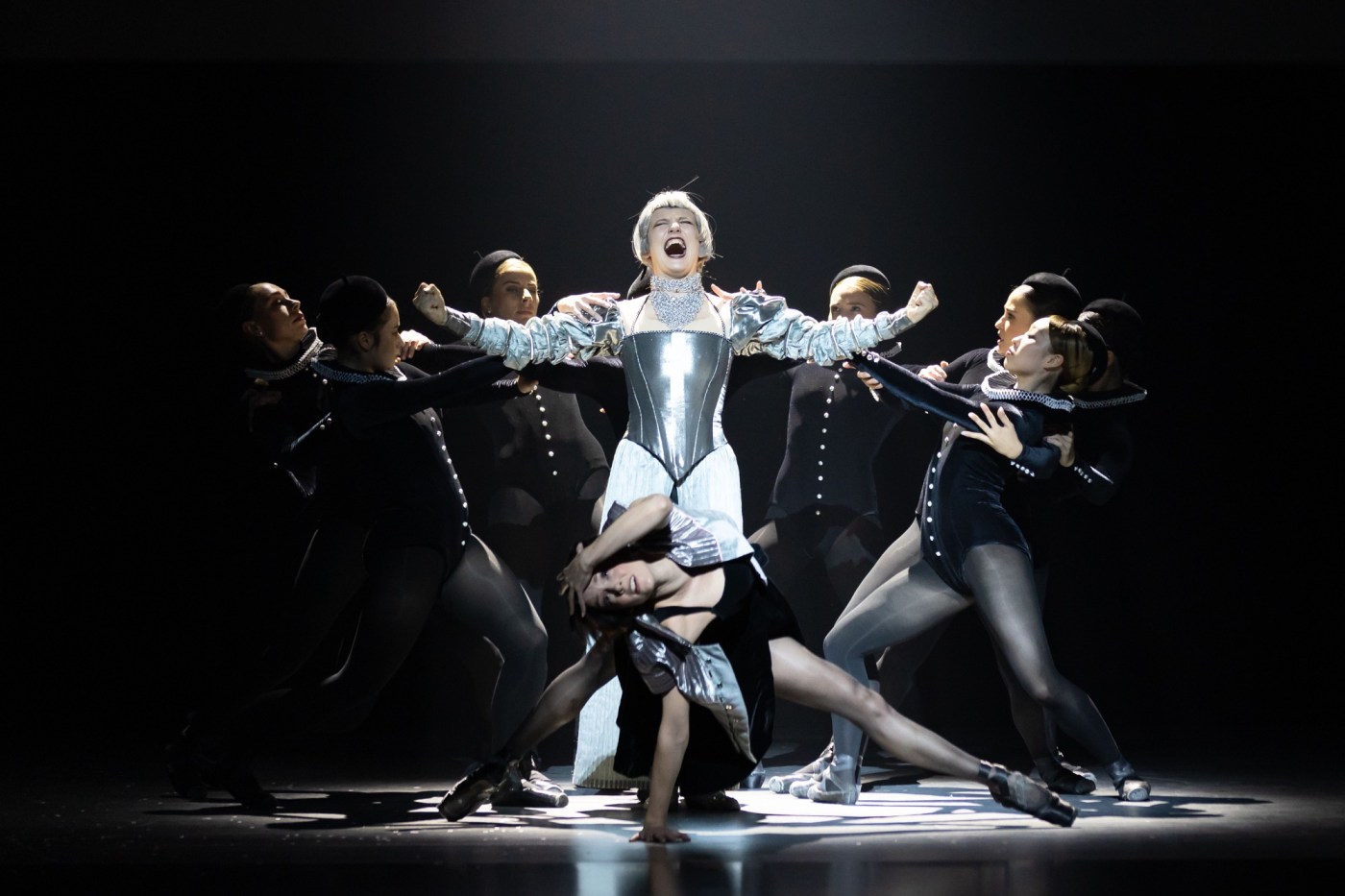
Scottish Ballet return to His Majesty’s Theatre Aberdeen this week with their intense, atmospheric and bold new production of Mary, Queen of Scots.
As Elizabeth I nears the end of her reign, she finds herself consumed by visions, both real and imagined, of her cousin and rival, Mary, Queen of Scots.
This exciting new production from Scottish Ballet’s choreographer-in-residence Sophie Laplane, co-created with James Bonas (Scottish Ballet’s 2025 production of The Crucible), delves into the charged relationship between two of history’s most formidable women, who never met.

Roseanna Leney stuns in the titular role of Mary. She is utterly captivating on stage, conveying the emotional arc of the tragic queen with precision. Despite her petite frame, Leney commands the stage with presence and power, filling the space with ease. Her ability to merge seamlessly with those around her – while never losing grip of her character – is exceptional.
Guest artist Charlotta Öfverholm lends emotional weight to the role of Older Elizabeth. Her commanding stage presence and masterful storytelling deepens the emotion of the piece. Her movements are sharp and deliberate, layered with vulnerability and fragility. We witness the story unfold through Elizabeth’s eyes – almost similar to Scrooge in A Christmas Carol, guided through the past, present, and future of her decisions. This journey is beautifully facilitated by Öfverholm and Kayla-Maree Tarantolo as the Jester. As an audience member, there is a feeling of safety as Tarantolo prances onstage. Tarantolo is a total standout, delivering a performance that carries both narrative and trickster elements. Her comedic timing is impeccable, yet it’s in the quieter moments where she truly shines, adding depth and softness to the production’s emotional narrative. Tarantolo does well to keep the narrative moving at pace, without losing detail.
Harvey Littlefield gives a powerful, standout performance as Younger Elizabeth. Their tall, striking presence offers a stark visual contrast to Öfverholm’s older counterpart, yet when the two move together, it’s as if two bodies move as one. Littlefield captures Elizabeth’s inner turmoil with clarity, especially as her resolve hardens toward Mary’s execution.

Evan Loudon delivers a beautiful performance as Darnley, a member of the English court sent to form an alliance with Mary. His portrayal is cunning and strategic, with the power dynamics in his relationship with Mary immediately clear. His death at the start of Act II is a standout moment, seen through Older Elizabeth’s distorted lens. Accused of murdering Darnley, Mary is imagined by Elizabeth as a spider devouring her prey – one of Laplane’s unnerving choreography choices, cleverly reflecting Elizabeth’s deteriorating state of mind in her final days.
Loudon shares compelling chemistry with Andrea Azzari as Rizzio, Mary’s private secretary, whose brutal murder plays a pivotal emotional moment. Their interactions as a pair are both fiery and tender, showcasing the versatility of both performers.

Thomas Edwards excels as Walsingham, Elizabeth’s spymaster and chief advisor. His energy is relentless, and his Act I sequence alongside the ensemble of spies is a highlight. He embodies Walsingham with a sinister, strategic authority, adding urgency and tension to the narrative throughout.
Other notable performances include Madeline Squire as both Catherine de’ Medici and James VI and I – her ability to embody two contrasting roles with such distinction is incredibly impressive. James Garrington stands out as the Dauphin, while Melissa Parsons, Danila Marzilli, Alice Kawalek, and Hannah Cubitt shine as the Four Marys. The wider company includes – Claire Tjoe-Fat, Grace Horler, Elizabeth Williams, Gina Scott, Urara Takata, James Garrington, Harvey Evans, Yuri Marques, Theo Greenfield, James Reid, Hamish Longley, Augustin Cimbault, Mackenzie Jacob, Eado Turgeman, and Alfie McPherson. The company perform with fluidity, intensity, and purpose. Their ability to shift from sweeping ensemble work to seamless transitions truly is testament to the strength and versatility of the company.Mary, Queen of Scots marks a homecoming for Aberdeen born dancer Alfie McPherson, now a company member with Scottish Ballet. McPherson first caught attention as one of 24 talented young performers cast in Matthew Bourne’s Lord of the Flies in 2014. A former student of local dance school Danscentre, he went on to train professionally at the Central School of Ballet in London and the Hamburg Ballet School. His professional credits include performances with Hamburg Ballett and Ballet Vorpommern – now, he makes a triumphant return to the Aberdeen stage with Scottish Ballet.
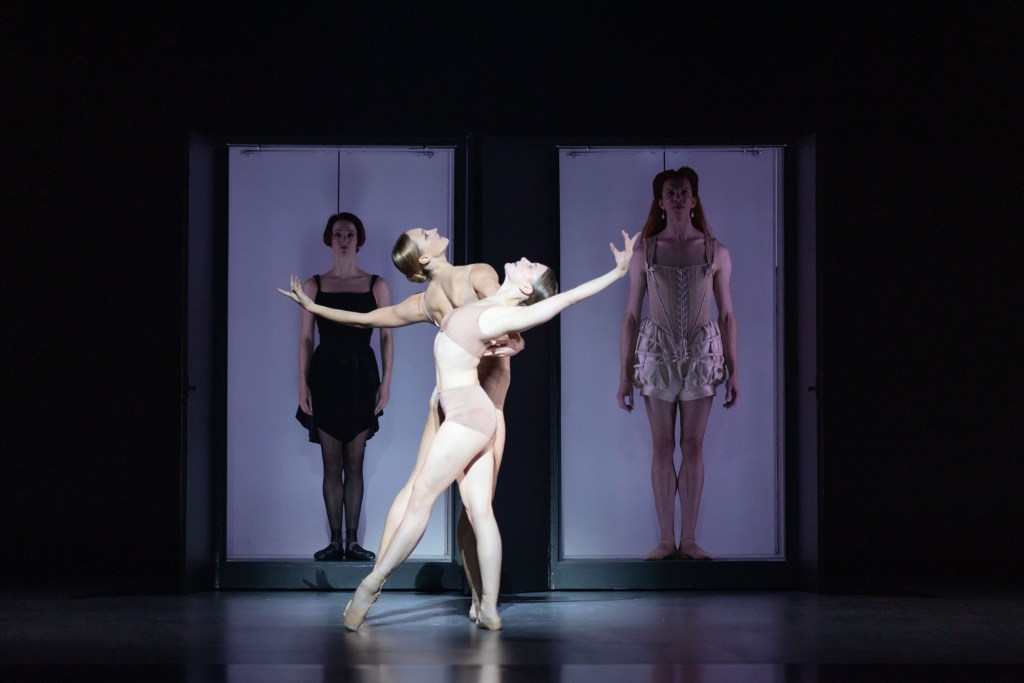
Soutra Gilmour’s modern, minimalist set design serves as a dramatic canvas for the piece and is atmospheric from the moment the curtain rises. Use of projections (design by Anouar Brissel) was well thought out and never overused, working in tandem with lighting design from Bonnie Beecher. Gilmour’s costumes, which evoke both the regal atmosphere and the rebellious flair of the punk era compliment to the overall vision of the piece and Laplane’s choreography, with the company moving freely with expression and never seem hindered.
The production features an original score by the composers behind Coppélia (2022), Mikael Karlsson and Michael P Atkinson which feels as bold as the piece itself. Never predictable but leaning into the whimsy, traditional Scottish sounds whilst blending bold, alternative elements to support different characters throughout the piece.
Director & Co-Creator, James Bonas and Choreographer & Co-Creator, Sophie Laplane have created something truly special here. While ballet excels at conveying emotion and character, it often struggles with the weight of historical detail and information. However, approaching this piece through the eyes of a dying Elizabeth feels inspired – to see her interact with her younger self and Mary throughout, only enhances the storytelling elements. Bonas and Laplane seamlessly transport us into an imagined world where abstraction and narrative coexist in perfect harmony. Their vision, combined with Laplane’s innovative choreography, innovative use of fly work, and unconventional props (such as the balloon representing Baby James VI and the child Elizabeth never had) – is supported by a haunting score and striking set and lighting design. The result is a production that feels both grounded in history and boldly imaginative, immersing the audience while delivering a fresh and emotionally charged take on a familiar tale.
Scottish Ballet excels in presenting this legendary story, reimagined with a dark, edgy flair, adding a bold new chapter to the company’s modern repertoire. They continue to push boundaries, take risks, and embrace experimentation, and it’s through the diversity of the company itself that this vision truly comes to life.
Mary, Queen of Scots plays at His Majesty’s Theatre Aberdeen until Saturday 4th October before heading to the Festival Theatre in Edinburgh for the final stop on this limited tour run.
You can find out more here: https://scottishballet.co.uk/whats-on/mary-queen-of-scots/
 Theatre Scotland
Leave a comment