
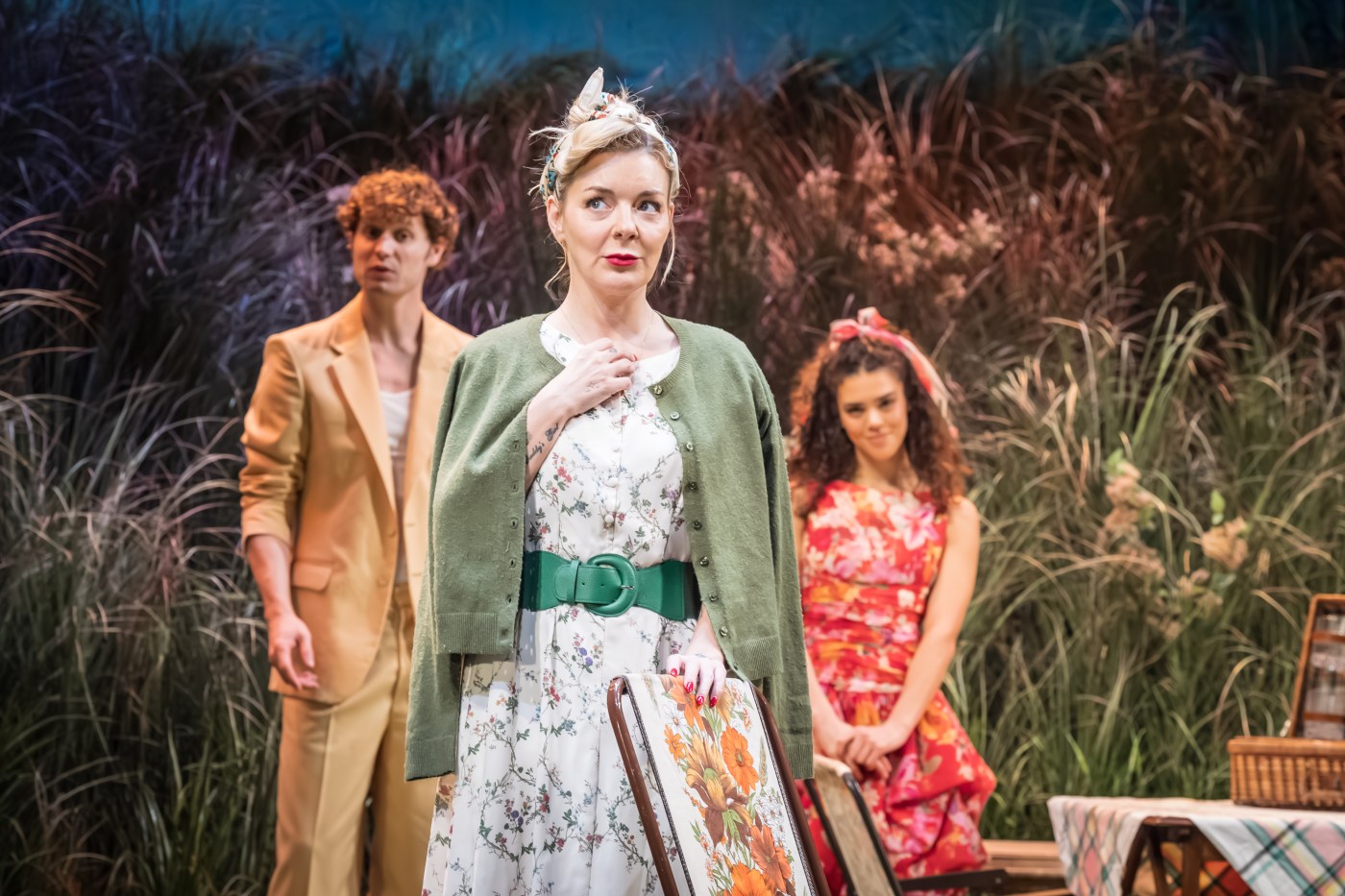
If you’re looking for a thought-provoking, surreal experience in Glasgow, complemented by a phenomenal cast, then get yourself down to the Theatre Royal for the exceptional ‘Woman In Mind’ playing the Theatre Royal, Glasgow, until Saturday 14th March 2026.
When Susan sustains a bump to the head, her world splits in two – one mundane, one imagined – and the lines begin to blur. Ayckbourn’s groundbreaking play is a hilarious and gripping exploration of identity, family, and mental escape.
Sheridan Smith as Susan is captivating within this performance. Smith bears her soul throughout this performance. She seamlessly weaves her way through the copious dialogue, using her voice and physicality to drive the character’s emotional journey. A performance not to be missed.
Louise Brealey as Muriel gives a great performance; her body language and facial expressions are quite often the source of comic relief throughout the performance. The role itself is quite thinly written, but Brealey makes the most out of her time on stage working within this.
Chris Jenks as Tony and Safia Oakley-Green as Lucy brought a great change in pace to the production. Both actors individually brought a new lease of energy and sustained it throughout the production. Jenk’s character choices were particularly interesting in the way the character felt like a tentative presence, paired with a slight hesitance in physicality – adding to the layers of the depth of the fantasy world we were being invited into. Oakley-Green made excellent choices in the delivery of her dialogue with sharp responses, adding to the youthful perspective of the character, embodying impatience and certainty.
Tim McMullan uses his character choices to bring a thoughtful restraint to Gerald, embodying a character whose intellectual composure becomes a barrier to emotional connection. These choices deepen the narrative that Susan cannot feel seen in her home. McMullan also finds quiet comedy in the delivery of his dialogue towards Muriel, which is more impactful than leaning fully into the comedy of the text.
Sule Rimi as Andy grabs the attention of the audience from the offset, Rimi has a wonderful stage presence which demands the room. The character journey is well balanced as he paces the sentimental, idealistic interpretation of what Susan would want in a husband, leaning on the seductive qualities of the character, to then reflect the more self-absorbed, destructive qualities of the character.
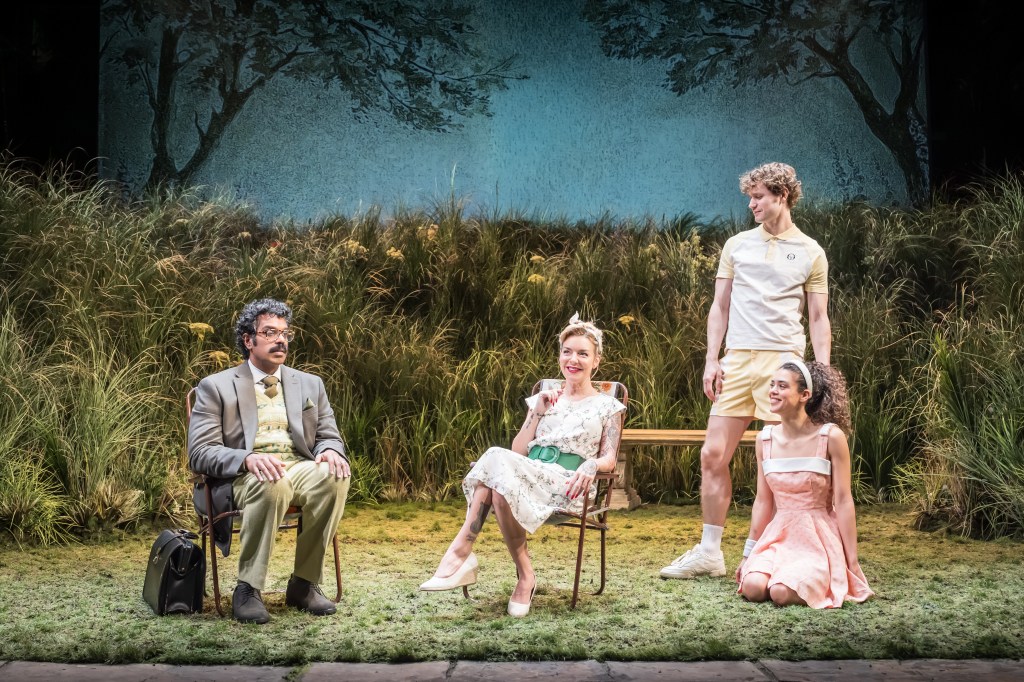
Taylor Uttley as Rick uses an understated naturalism which grounds the production while subtly contributing to the social awkwardness and miscommunication that surrounds Susan. This naturalism is achieved by the delivery of his dialogue as well as minimalistic body language achieving the contrast required to highlight the surrealism of the world we are watching unfold.
Romesh Ranganathan’s relaxed comic presence initially brings lightness to the stage, yet this ease only emphasises the underlying discomfort as Susan’s increasingly fragile state heightens. Although a lot of Ranganathan’s character choices are those that are quite obvious in nature and somewhat predictable, the role of the character is achieved and contributes to the discomfort of the collapse of Susan’s world.
Alan Ayckbourn seems to hit the nail on the head in terms of capturing the emotional architecture of domestic life. Capturing that when taken for granted, devotion can erode the person who offers it. Most radically, the play stands the test of time as it highlights how easily a woman can vanish under the weight of expectation and how escapism can often be a reflection of the longing for recognition and appreciation. This of which I’m certain to this day, many women can resonate with. Beneath the surrealism, Ayckbourn’s writing exposes the quiet erosion that can occur within domestic life, where years of unacknowledged care and accommodation leave a person struggling to locate a self beyond the roles they perform.
Michael Longhurst’s direction was particularly interesting, in moments where the theatre is plunged into darkness, the audience is briefly suspended in the same uncertainty that governs Susan’s world, transforming disorientation into a shared experience rather than a purely dramatic device. However, a lot of the action takes place downstage, which can become difficult in terms of sightlines depending on the venue. Despite being in the circle, I found myself having to listen to some of the action which was slightly disappointing given Smith’s captivating performance. I enjoy the intimacy of the action being so close to the audience; however, perhaps more intimate staging as a whole would work better for this show.
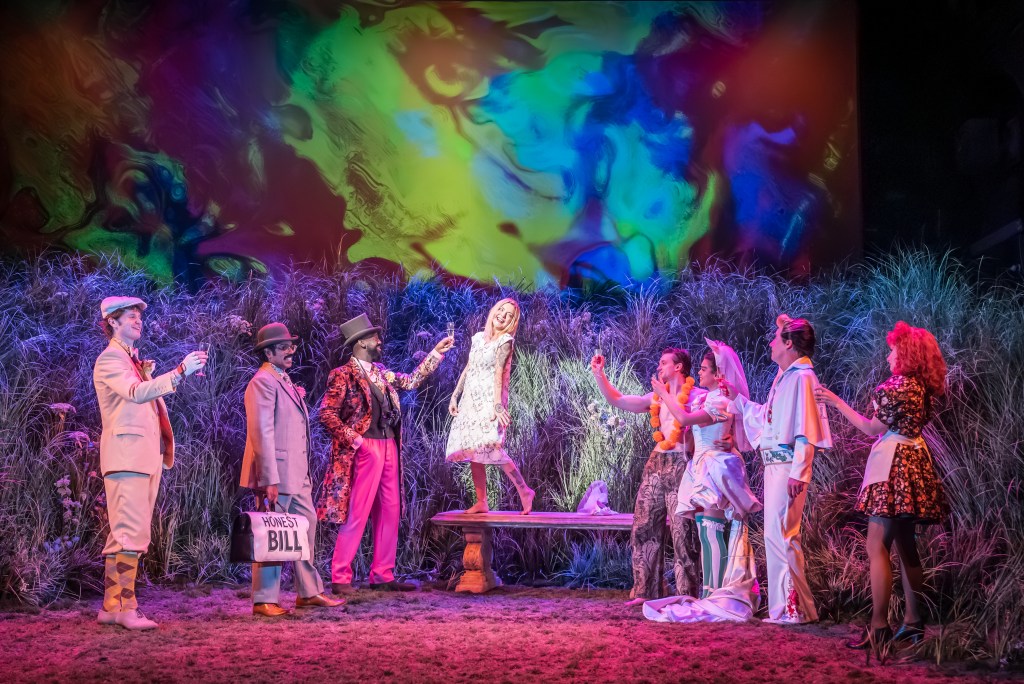
The set designed by Soutra Gilmour transforms a suburban garden into a psychologically charged landscape, where dense natural growth and shifting digital projections allow the space to move fluidly between reality and the vivid, hallucinatory world of Susan’s imagination. The set was layered wonderfully, the use of minimal outdoor furniture, keeps a familiarity to the space, leaving it feeling both grounded and unstable.
Ultimately, this production of Woman in Mind proves why Alan Ayckbourn’s play continues to resonate decades after its premiere. Under Michael Longhurst’s direction, the surreal humour and psychological unease of the piece are brought vividly to life through a committed ensemble and imaginative staging. Sheridan Smith’s fearless central performance anchors the production, while the surrounding cast and striking design elements build a world that feels familiar and quietly unsettling.
Get your tickets here – https://www.atgtickets.com/shows/woman-in-mind/theatre-royal-glasgow/
 Theatre Scotland
Leave a comment