

What if science finally conquered death? Lifelong, the latest collaboration between playwright Lynda Radley and Pepperdine Scotland, takes this seemingly utopian premise and asks even darker questions: who gets to decide who lives, who benefits from scientific progress, and what happens when the pursuit of a longer life comes at the cost of living freely?
Set inside an isolated “wellness” facility, Lifelong introduces us to the Pioneers, a group of scientists who helped develop the technology that allows humans to stay young and healthy for centuries. Their reward is a perfect existence, with every need catered for, and every cause of stress carefully eliminated. As the show puts it, “stress is the enemy of a long life.”
The story follows disruption to Pod One’s perfect bubble, when Kit, an outsider from “the edge” arrives. Unlike the Pioneers, Kit is “unenhanced”, meaning he has not received the treatments, and lives a normal aging life. What initially feels like a straightforward divide between the privileged and the less so, develops into a more complicated exploration of wealth, scientific advancement, control, and what genuine care looks like.
This is the second collaboration between Radley and Pepperdine Scotland, following their previous production winning a Fringe first award. Pepperdine Scotland brings together Scottish theatre practitioners with students from California’s Pepperdine University, making Lifelong an interesting international collaboration, and a perfect representation of what Edinburgh Fringe is all about. The production is presented in association with Scottish theatre company Scissor Kick, whose work focuses on observant, transformative, and often unsettling theatre. Their involvement is particularly appropriate for a production such as this, concerned with technology, inequality, and the consequences of unchecked power.
Director Hollace Starr keeps the production moving at a comfortable pace, while dramaturg Tom Creed and producer Stephanie Katie Hunter help shape a production that is ambitious in its ideas. The technical team deserves particular recognition. Scenic designer Mak Burke creates an appropriately clinical environment, with Burke also overseeing props and wardrobe alongside Ade Zepeda. Melanie Watnick’s costumes, particularly the Pioneers white tracksuits, immediately establish the controlled and clinical environment with a crisp and clean aesthetic. Aaron Quevedo’s lighting is exceptional, with the cool blue illumination giving the facility both a dreamlike, and cold quality, while Paul Dufresne’s production management helps bring all these elements together. Tamryn Liddle and Ava Walters provide stage management support, while Sarah Miele’s choreography contributes to the show’s physical language.
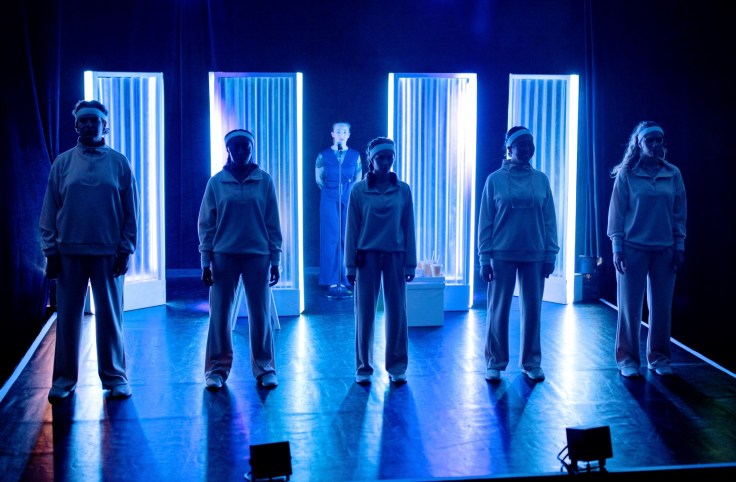
Sound is very important to the atmosphere created, with the music contributing to an increasingly unsettling undertone throughout, and making the scene transitions pop. The production frequently transforms the space through light, sound, and movement, rather than relying on elaborate scenery, making the most of its Fringe studio setting.
The cast consists of 12, featuring James Davis IV as Kit; Mandy Tatum as Eden; Hailey Soomin Lee as Viv; Eden Gamble as Billie; Hadassah as Frances; Skyla I’Lece as Stella; Nathan Roberts as Alex; Cassius Franciosa as Everest; Nicolle Assumpcao as Ami/Sam/Quinn; Brooklyn Courtney Moore as Eve/Arbour/Jamie; Blake Schalliol as Linden Brin/Gabriel/Jayden; and Kysiah Tapia as Mae/Pleasance/Charlie.
This ensemble is strongest when the production allows its characters to move beyond just the ideas they represent. Courtney Moore is particularly outstanding as Eve, bringing emotional depth and control to the story, while Franciosa, Schalliol, and Soomin Lee are also standout performers. Assumpcao is another memorable presence, playing the AI Ami convincingly.
Davis’s Kit grows into the role. His performance can feel somewhat restrained in the earlier sections, with some dialogue feeling a little awkward at times, but when Kit is given more emotional material, Davis comes into his own and brings a vulnerability that stands out in the performance.
There are moments when Lifelong feels like its still finding its feet. The number of characters and identities can make the earlier sections trickier to follow, while some dialogue feels a little unnatural. Some performances land a little emotionally flat in the earlier parts of the show, but the production becomes increasingly confident as it progresses. The final 30-minutes are where Lifelong finds its emotional centre and shines.
Ultimately, Lifelong asks us whether living longer necessarily means living better, and whether scientific progress should always be pursued simply because it can. It also asks us to consider what happens when the rich and powerful have enough control to decide who gets access to the progress, and ultimately, who lives or dies.
Ambitious, visually impressive, and increasingly affecting, Lifelong may occasionally stumble in its execution, but its questions linger long after the lights go down.
Lifelong runs at Assembly George Square in Studio 2 from 7-17 August 2026 at 12pm.


Leave a comment