Giving the audience the power to decide how an entire murder mystery will unfold is a bold move, but it is exactly the format Murder, She Didn’t Write takes. Now in its 12th year at the Edinburgh Fringe, Degrees of Error’s show borrows a 1930s Agatha Christie-style mystery format and puts it into the hands of the audience.
The performance begins with some lilting piano music played on stage by the talented Richard Baker as we get seated, which if you’ve read any of my previous reviews, you’ll know I’m a fan of! Once the show kicks off, suggestions are shouted out by the audience, first for an event, and then an intriguing item, noted down by famed detective, ‘Agatha Crusty’ played by the incredible Lizzy Skrzypiec. At the show I attended, exciting suggestions such as “the swimming Olympics” and “an influencer’s baby shower” were suggested. From there, an audience member is selected with a throw of a hat to become “Jerkins”, the evening’s assistant, who makes some crucial decisions, including selecting the victim and murderer for the show.
Both are kept secret from the audience, meaning that as performers begin constructing the mystery, the victim is a shock, and you must pay attention to work out who is responsible for the murder. It is a wonderfully simple mechanism that turns the entire room into amateur detectives, sitting on the edges of our seats.
The cast and crew create an entire 1930s world from scratch, starting with an incredible set designed by Justin Williams. The set dressing established the world of the mystery before the performers even begin to build it, using time-appropriate props such as a luxurious velvet green chaise, and old dusty looking bookshelves.
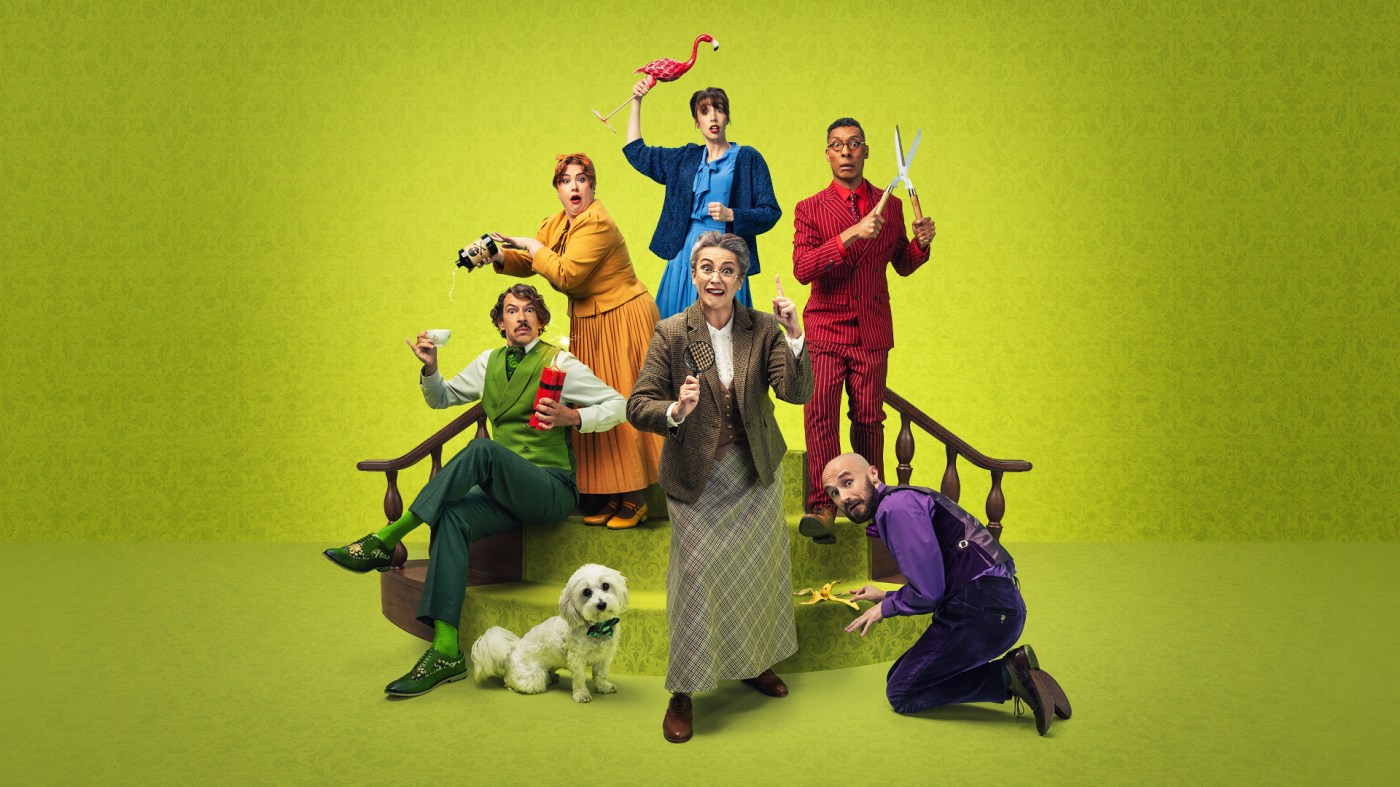
At the showing I attended, the world was populated by Barbara Blue (played by Sylvia Bishop), a scientist developing an unusual 3D printing technique; Polly Puce (played by Caitlin Campbell), her ex-swimmer, bard sister; Ruby Rose (played by Rachael Procter-Lane), a palaeontologist and member of the Church of Dinosaurs and Creationism; Gregor Gold (played by Peter Baker), an American who founded the Smithsonian; and Arthur Hewlett-Packard (yes, that Hewlett Packard — played by Stephen Clements), a wealthy investor possessing a mind-reading hat who wants to destroy the world with his rubbish printers.
The characters are cleverly named after colours and dressed in their corresponding colour-scheme costumes, designed by Lu Herbert, making the cast recognisable and easy to keep track of throughout. The rotating ensemble includes the above performers, as well as Harry Allmark, Rosalind Beeson, Emile Clarke, Monica Gaga, Alice Lamb, Emily Rose, and Matthew Whittle, who all bring these characters to life with remarkable energy. The performers then spend the next hour or so throwing each other under the bus, prompting each other to improvisationally sing, rap, dance, and rhyme, and gleefully building on whatever ridiculous idea has just been introduced.
This results in an extraordinary display of wit and cleverness. The cast bounce off each other’s ideas with remarkable ease, and their ability to turn accidents into comedy is brilliantly impressive. A mistimed entrance or momentary technical lag becomes another opportunity for a joke, never disrupting the show. Even better, the performers regularly have to stifle a chuckle or play off a laugh, as they too are so utterly affected by the absurdity of the show – especially our detective, Agatha Crusty, who can so regularly be heard giggling through her lines that it’s infectious.

What makes the production most impressive is how much of the theatrical machinery is improvised alongside the actors on stage. Sound designer Lucy Baker-Swinburn creates effects live, responding to changes in the scene, while an on-stage pianist provides improvised music that subtly establishes atmosphere without overwhelming the action. Lighting designer Adam King follows the performers with precision, managing blackouts, spotlights, house lights, and scene changes, despite having no script to follow. It is an exceptional feat of coordination, particularly with every element being created in the moment.
By the end of the show, a full drama has emerged, with secret romances, scandals, competing motives, flashbacks, and increasingly elaborate misdirection. Eventually, poor Gregor Gold meets his end with a dinosaur egg being driven through his abdomen, leaving him face down on a table in the 3D printing room, with his mind-reading hat perched rather unfortunately on his backside. It is ridiculous, theatrical, and exactly the sort of wonderfully convoluted murder you could only get from a show like this.
From there, Agatha Crusty, who has somehow become a “dinosaur detective” (part detective, part dinosaur scientist), has to piece together the various affairs, scandals, and motives that have emerged and construct a coherent explanation for Gold’s death, pointing to the killer that was selected by Jerkins before the show. The murderer was revealed to be Arthur Hewlett-Packard gasp, who is then forced to recreate the murder and explain exactly how he pulled it off. And don’t worry about spoilers, because each show is entirely unique!
And thus we see the magic of Murder, She Didn’t Write in all it’s glory. Because the audience creates the key plot points for each show, every single day unfolds a new mystery to be discovered. I could happily binge watch an entire series of this, and wish I could return every day to see each and every combination of chaos.
Murder, She Didn’t Write is perhaps the most brilliant piece of improv theatre at the Fringe, with its wildly funny, remarkably clever cast and crew, and is an absolute joy to watch.
Murder, She Didn’t Write runs daily from 5-31 August 2026 at 2:15pm at Assembly George Square, in the Gordon Aikman theatre.


Leave a comment