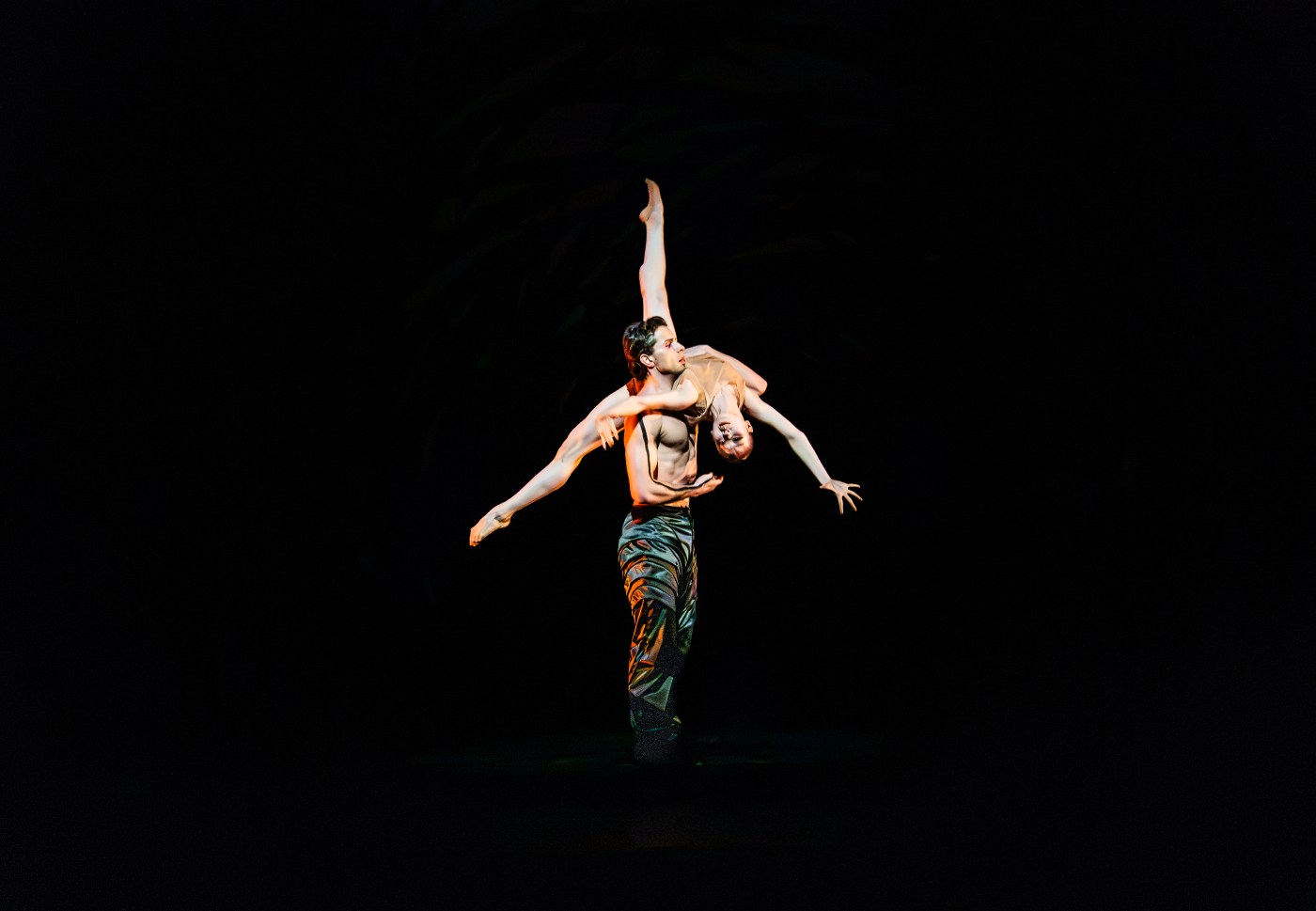
Crystal Pite’s Emergence returns to Scotland for the first time in ten years and certainly creates a buzz at His Majesty’s Theatre this week, with a limited three-show run of this breathtaking fusion of classical ballet and raw, insect-like movement. The company is transformed into a swarm of creatures inhabiting a dark, alternative universe, creating spectacular formations that continually blur the boundaries between individual and collective being.
The piece itself presents two works. Act 1, marking a world premiere for Scottish Ballet, is Entress by Julia Cheng, the acclaimed choreographer behind Cabaret at the Kit Kat Club, whose boundary-crossing work has earned Olivier and Chita Rivera Award nominations. Entress is an old Scottish word meaning ‘the right to enter’ or ‘an entrance’, and the title feels particularly fitting for Cheng’s work, which acts as a gateway into the multitude of themes she explores. This is Cheng’s first commissioned work in a number of years, following her work on Cabaret at the Kit Kat Club and the birth of her child. Cheng herself describes her practice as non-linear, but rather as “fragmented poetry” – and that description feels entirely apt here.
Within Act One, Kayla-Maree Tarantolo presents as our protagonist. I have been very lucky to see Tarantolo in a variety of roles as a soloist with Scottish Ballet, including Abigail in The Crucible and The Jester in Mary Queen of Scots. Entress pushes her ability, fluidity and range as both a dancer and a storyteller, demanding a physicality that feels instinctive while retaining an extraordinary level of technical precision.
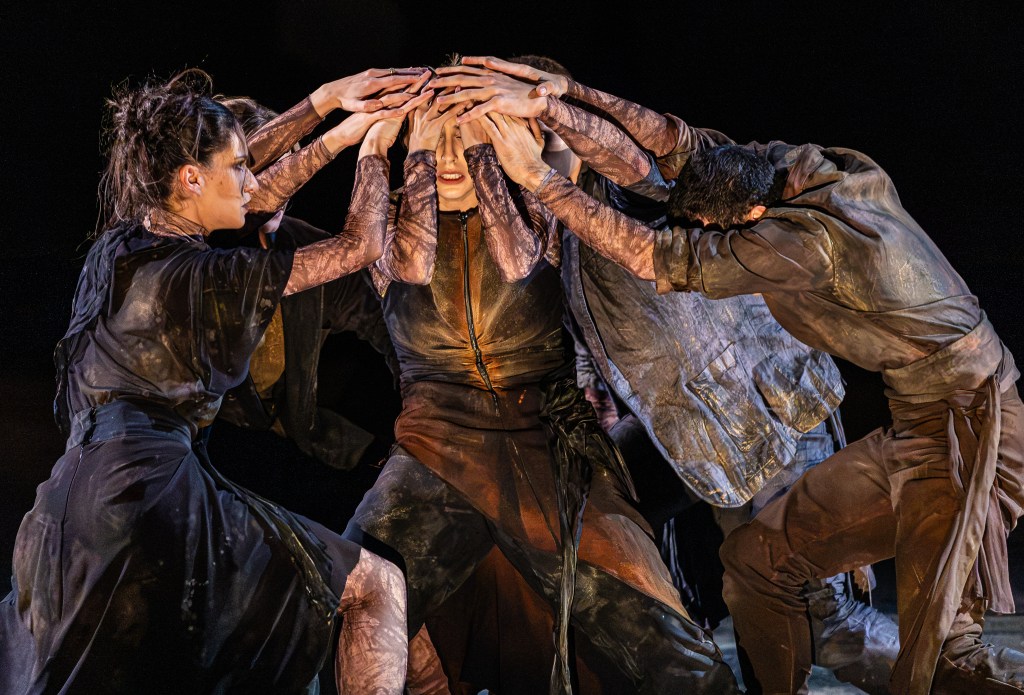
Image: Scottish Ballet, Entress
She is accompanied by Rishan Benjamin as Nuwa, drawing inspiration from the Chinese goddess of the same name, who is half woman, half snake, credited with the moulding of humankind. Benjamin is a particular standout, both in this piece and later in Emergence. Her precision, storytelling and masterful technique are truly mesmerising. Benjamin appears as an ethereal being at the centre of the golden chrysalis set piece, which moves as though it possesses a living, breathing entity of its own.
Yipeng Xu features as the Messenger, with a performance fuelled by emotional urgency and precision. Xu leads and works with the ensemble throughout, complementing the piece beautifully and providing a compelling thread through Cheng’s fragmented narrative.
Tarantolo and Benjamin’s final duet is stunning: two bodies moving as one while remaining stylistically distinct, their contrasting qualities complementing each other beautifully. It is a testament to Cheng’s choreography, created alongside Associate Choreographer Laura Braid, and to the remarkable physical language they have developed.
The choreography is beautifully accompanied by music from composer Isobel Waller-Bridge – yes, the sister of writer, producer and actor Phoebe Waller-Bridge, best known for her work on Fleabag. Here, Waller-Bridge’s atmospheric and emotionally charged compositions are central to the identity of the piece. Cheng, Story Consultant Nick Drake and Waller-Bridge have created something genuinely special together.
The seamless blend of more classical tonalities within the score with the pulsating beats of Cheng’s longtime collaborator and guest percussionist BeiBei Wang, who also serves as Artistic Associate, creates the perfect soundscape for an intense work rich in narratives of destruction, decay, loss and grief.
Entress almost feels like a panic attack unfolding on stage – in the most positive sense possible. The ensemble embraces Cheng’s hip-hop and waacking, an expressive dance style originating in the 1970s club scene, using these techniques to occupy intimate spaces and build an honest, highly individualised form of expression. They often possess characteristics not too dissimilar to the ‘Clickers’ in The Last of Us – a late stage of zombie infection that uses rapid, guttural clicking sounds to navigate and hunt prey in the dark. There is something visceral about watching the company move through these contrasting moments, shifting between restraint and release with remarkable fluidity – almost like sand, moulding as the earth moves around it – the earth in this case being in the form of our protagonist, Kayla-Maree Tarantolo.
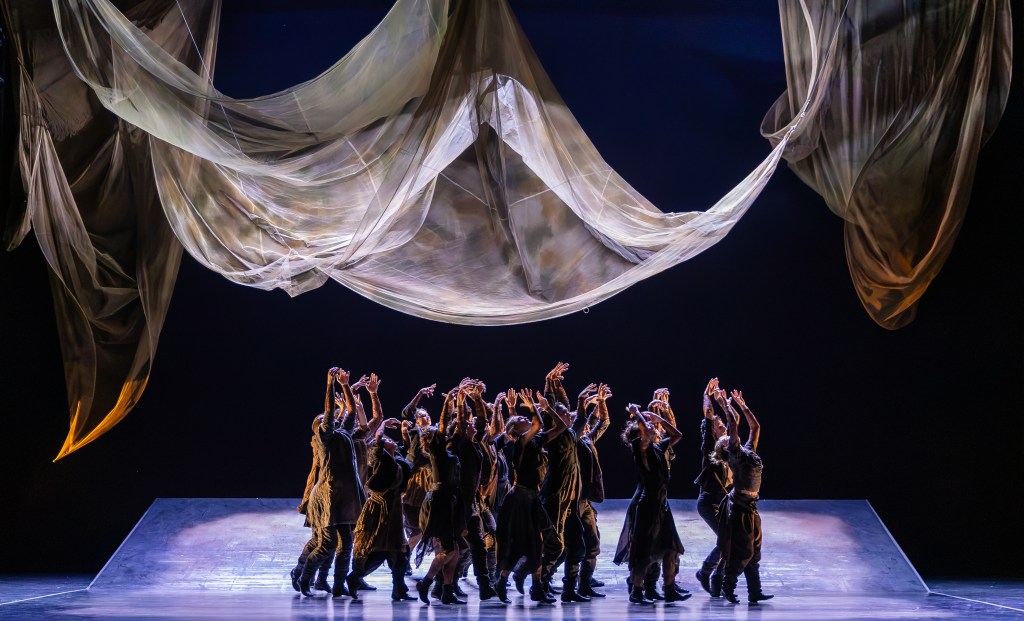
Image: Scottish Ballet, Entress
I have reflected on the last few times I have seen a Scottish Ballet production: the company is at its strongest when it is moving as one core entity and being. Both Entress and Emergence are testament to that statement, showcasing the company at its considerable strengths – uniform, precise and cohesive, yet ultimately unique and diverse all at once.
With swooping golden sheaths overhead and an optical-illusion set piece from set and costume designer Yann Seabra – the set and costumes enhance the technical demands of the choreography beautifully, complemented by Lee Curran’s lighting design, which works in tandem with both the movement and the music.
The ensemble for both pieces consists of Artists of Scottish Ballet: Marlen Fuerre Castro, Jessica Fyfe, Rosenna Leney, Uri Marques, Bruno Micchiardi, Grace Holter, Harvey Littlefield, Melissa Parsons, Rimbaud Patron, Gina Scott, Claire Souet, Andrea Azzari, Hannah Cubitt, James Garrington, Alice Kawalek, Urara Takata, Benjamin Thomas, Anna Williams, Charley Austin, Matthew Bates, Rafael Bejarano Vidal, Antonia Cramb, Williams Davolls, Harvey Evans, Lewis Formby, Calum Gray, Theo Greenfield, Mackenzie Jacob, Hamish Longley, Sebastian Marriot-Smith, Danila Marzilli, Annabelle McCoy, Alfie McPherson, Mayu Takata, Claire Tjoe-Fat, Elizabeth Williams and Seria Winning.
Act Two presents the titular work, Emergence. Featured throughout are Urara Takata and Harvey Evans (Duet Prologue); Rishan Benjamin and Lewis Formby (Duet Grand Pas); Matthew Bates, Hamish Longley, James Garrington, Andrea Azzari, Yuri Marques and Rimbaud Patron (Sextet); Grace Horler, Melissa Parsons and Roseanna Leney (Trio); James Garrington and Calum Gray (Tunnel Duet); Andrea Azzari (Beeman solo); and Anna Williams, Yipeng Xu, Yuri Marques and Rimbaud Patron (solo/quartet).
Coming in at a tightly paced 30 minutes, each solo and pas de deux intertwines beautifully with the full-company sequences, which ultimately form the beating heart of Emergence.
Drawing from research into swarm intelligence and bee colony behaviour, Crystal Pite explores the tension between our craving for individuality and our deep-rooted need for collective belonging. The company repeatedly counts to twelve audibly, both in and out of sync, before eventually becoming climactically unified and collapsing at the end of the piece.
This prompted me to research the significance of the number twelve within the bee world, and it turns out to have a particularly fitting connection to honeybees: a single worker bee produces only around one-twelfth of a teaspoon of honey over the course of its lifetime. That detail adds another fascinating layer to Pite’s inspiration for the piece. As the choreography builds and the company moves almost seamlessly between individual impulse and collective instinct, the dancers begin to resemble an army, a colony and a hive mind simultaneously.
Owen Belton’s score feels electric and earthy all at once, beautifully complemented by the moody lighting design of Alan Brodie. These elements, alongside Jay Gower Taylor’s set – an open, dimly lit stage with a swirling tunnel positioned centrally in the upstage area – and Linda Chow’s costumes, enhance the physicality of the company beautifully.
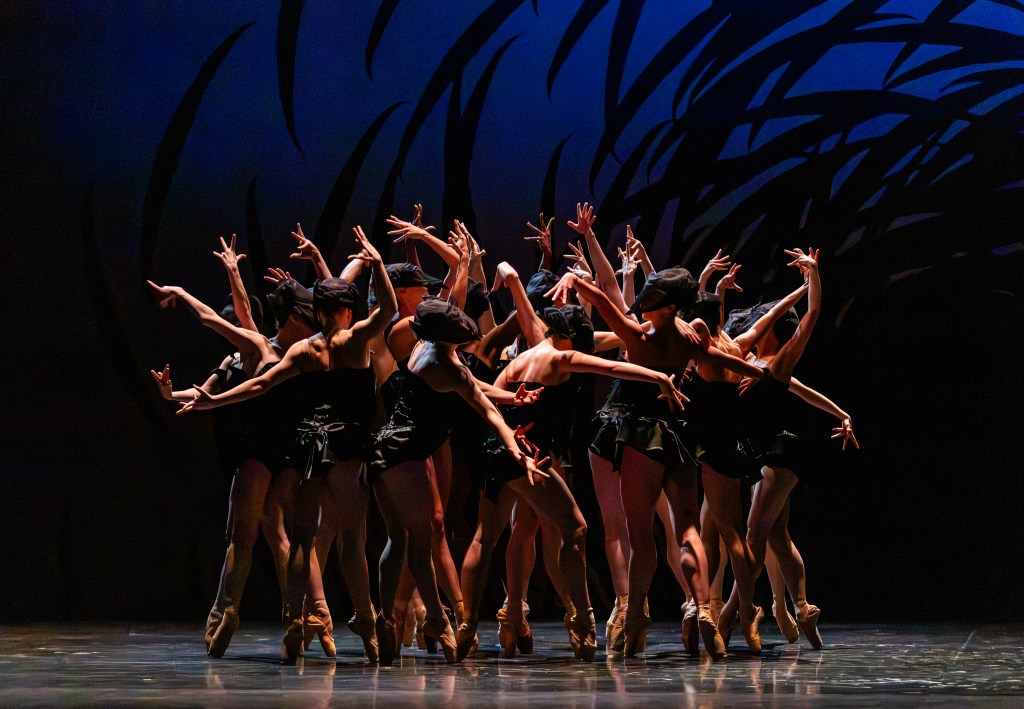
Image: Scottish Ballet, Emergence
Stagers Eric Beauchesne and Anna Herrman have assisted Crystal Pite in creating a truly masterful piece of storytelling. The work is visceral, disciplined and hypnotic, and its visual language blends beautifully with the contrasting world of Julia Cheng’s Entress, making this a remarkably cohesive double bill despite the distinct identities of the two works.
Emergence as a whole is a true testament to Scottish Ballet’s current company: diverse, entrancing, risk-taking, slick and excelling in both traditional and non-traditional storytelling.
Whilst it is clear – and has been demonstrated countless times before – that the company is well-versed in traditional ballet, its contemporary abilities are truly outstanding and a total marvel. There is a confidence in the way this company moves between classical technique and contemporary physicality, and both Entress and Emergence demonstrate just how expansive that range can be. The current Scottish Ballet company is an unstoppable force, tackling classical ballet and contemporary fusion with remarkable ease and leaving audiences awestruck.
Emergence plays two further performances at His Majesty’s Theatre, Aberdeen, on 26 September, before touring to its final Scottish dates at the Festival Theatre, Edinburgh, from 1–3 October 2026. Scottish Ballet will also take the piece to the Bergen International Festival in Norway in June 2027.
Tickets and more information here: https://scottishballet.co.uk/whats-on/emergence/
5 stars


Leave a comment