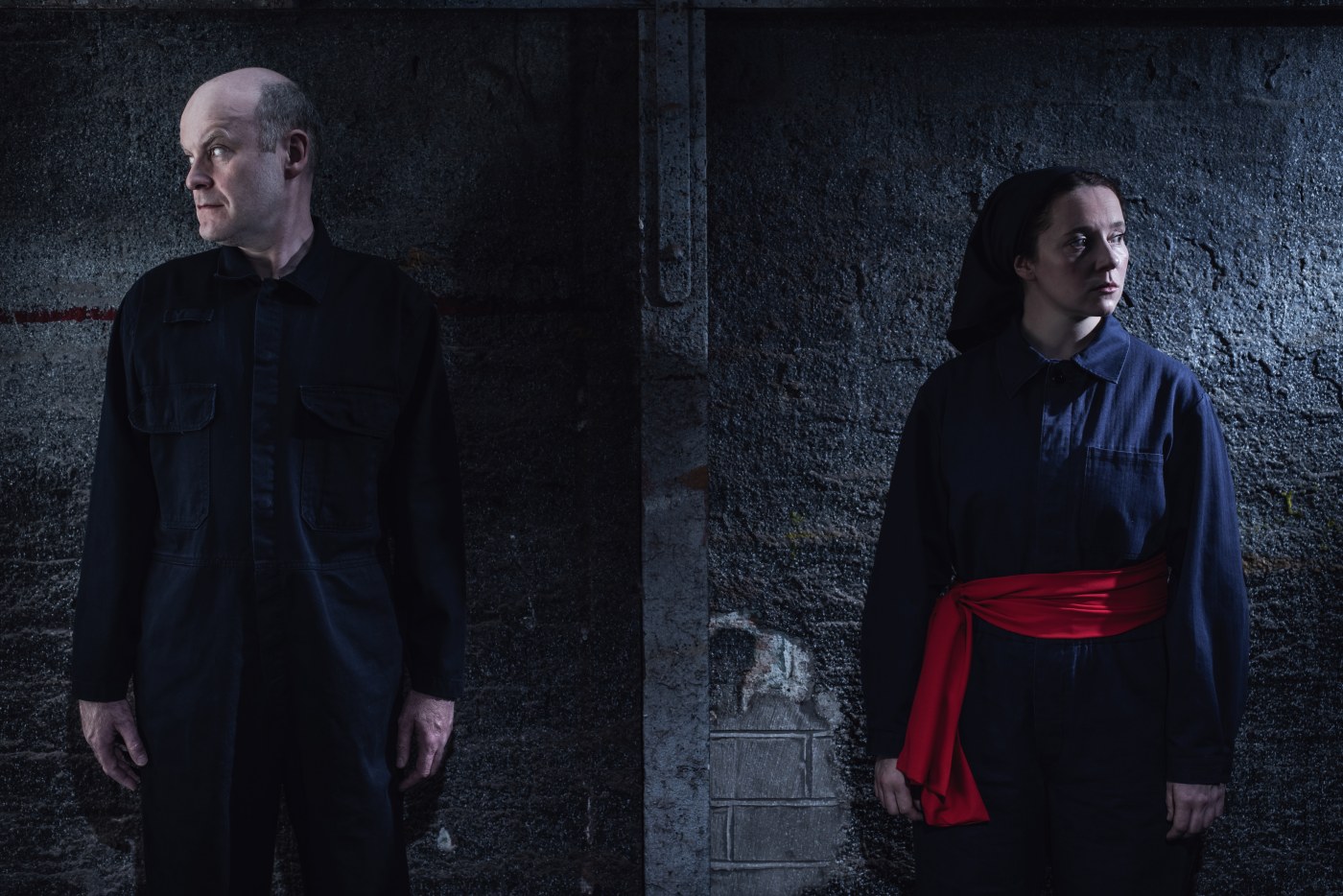
Citizens Theatre, Dundee Rep Theatre and Royal Lyceum Theatre present this new adaptation of George Orwell’s classic novel, 1984, adapted by acclaimed Scottish playwright Chris Hannan. In recent years, Orwell’s famous novel has surged back up international bestseller lists as readers return to its stark warnings about truth, power and control. Against the backdrop of today’s unsettling political climate, this new adaptation feels particularly relevant.
Set in a world of perpetually warring superpowers and constant historical revision, the story follows Winston Smith, a worker in the Records Department at the Ministry of Truth. When Winston meets Julia, the pair embark on a love affair that draws them into rebellion against the Party and Big Brother, fighting against all odds for the right to remain human. In a world where truth is manipulated and history rewritten, the parallels with our own political landscape are difficult to ignore.
Leading the eight-strong ensemble is Jack Tarlton as Winston/Orwell. Tarlton delivers a confident performance, capturing Winston’s vulnerability while bringing a sense of familiarity to Orwell himself, as the adaptation intends. He navigates the piece with apparent ease, moving between the two characters with conviction. Including Orwell as a character is an interesting addition and does provide much needed comic relief, although at times it feels a little on the nose – though that may well be the point.
Opposite Tarlton, Jessica Hardwick plays Julia, the middle-class woman with a yacht, alongside additional ensemble roles. Hardwick is a particular highlight, bringing much-needed light to an otherwise dark narrative. Just as Julia brings colour into Winston’s life, Hardwick introduces a welcome warmth to a world that feels almost entirely black and white before her first appearance. She and Tarlton work well together, successfully portraying a tentative, almost childlike romance against the emotionless backdrop of the Party’s regime.
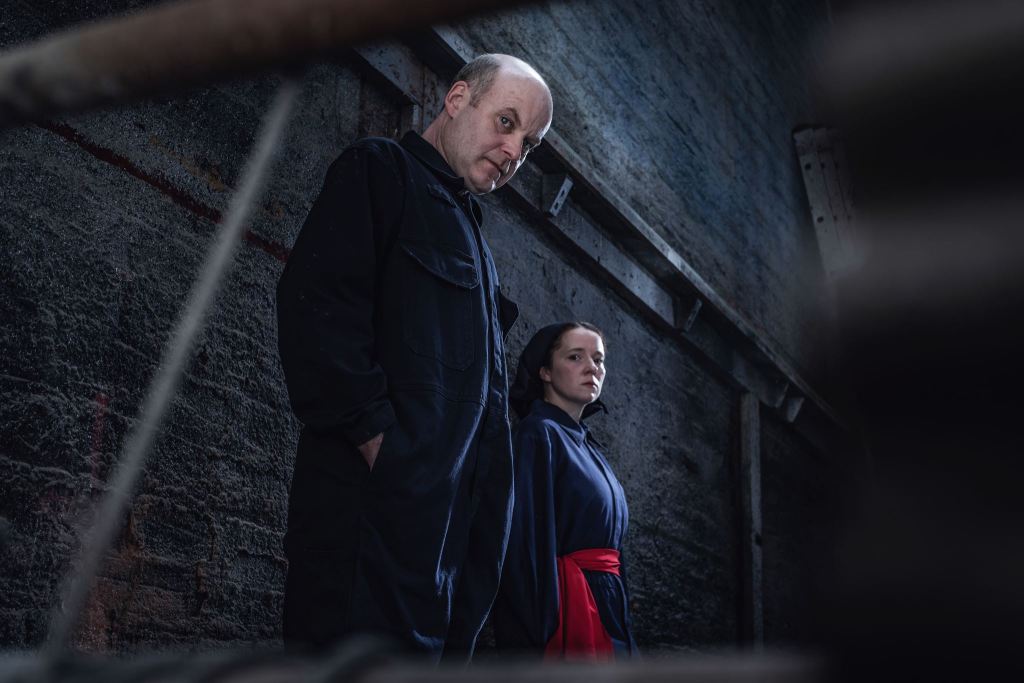
Photo: Alasdair Watson, Citizen Theatre
In moving the source material from Winston’s singular perspective to the stage, where multiple viewpoints can be explored, Hannan places additional emphasis on the relationship between Winston and Julia. This translates well theatrically, allowing the audience to invest in their romance and giving their connection greater emotional weight.
While much of the narrative rests on Tarlton’s shoulders, this production is equally reliant on its ensemble, with the cast multi-rolling throughout. Robert Jack stands out as Syme, Mr Dick and various ensemble characters, alongside Irene Allan as Mrs Syme, Mrs Ogilvy, Mother, Nurse Rankine and other ensemble roles. Together, Jack and Allan create striking contrasts between their characters, delivering such convincing transformations that it is easy to forget the same actors are playing multiple parts.
Irene MacDougall brings a commanding stage presence to O’Brien, becoming a particular highlight in Act Two as the story reaches its climax. The wider ensemble includes Neshla Caplan as De Souza, the Thought Policewoman and various ensemble characters; Peter Collins as Parsons, Charrington and ensemble; and Zrey Sholapurkar as Comrade Ogilvy, the Thought Policeman, a Prole, a Torturer and other ensemble roles. As a company, they work seamlessly together, contributing to the production’s slick feel. The cast take the material in their stride, bringing considerable versatility to the stage.
Director Dominic Hill, assisted by Ben Purkiss, has a bold vision for this production, although at times the result feels slightly removed from the audience. This may, in part, be a consequence of the staging. Despite feeling physically close to the action, I occasionally felt emotionally distant from it. Perhaps this detachment is entirely intentional, reflecting the dehumanising nature of the world Orwell created. Even so, I found myself wanting to feel more immersed in the horror unfolding before me.
Tom Piper’s set design is effective, particularly in Act Two, when what initially appears to be static, two-level scaffolding transforms before our eyes into the cells and Room 101. The dollhouse-esque sets are a particularly appealing feature, unfolding into the rolling hills where Winston and Julia first escape the watchful eye of Big Brother, as well as both Charrington’s shop and spare room leant to Winston and Julia for their illicit affair. Each additional set-piece collapses like a pop-up picture book, making for slick and satisfying transitions. There is perhaps an opportunity to make greater use of the upper level of scaffolding throughout, but the overall design provides a strong visual foundation for the production.
Piper’s set is complemented beautifully by Lizzie Powell’s lighting design, which enhances the quieter moments on stage with particular sensitivity. From the smoke of cigarettes to the dust rising from a chalkboard, Powell finds atmosphere in the smallest details. Her lighting also lends warmth to the memories Winston shares with the audience, creating a sense of intimacy, as though these recollections belong to us, too. Similarly, in stark contrast to the depths of Room 101.
The score is a collaborative effort, with music composed by Nikola Kodjabashia, associate electronic composer Phineas de Thornley Head and sound designer Mark Melville. The result is frequently jarring and somewhat anxiety-inducing, with sudden droning startling multiple audience members at the beginning of both acts and at points throughout the performance. While this certainly contributes to the unsettling atmosphere, the scoring occasionally feels less purposeful than it might. The droning sound that accompanies the torture scenes, for example, begins to feel repetitive against the similar sounds heard earlier in the production. There is also room to explore how sound might further communicate Winston’s psychological unravelling, particularly as his memories begin to leave him during his arrest and torture.
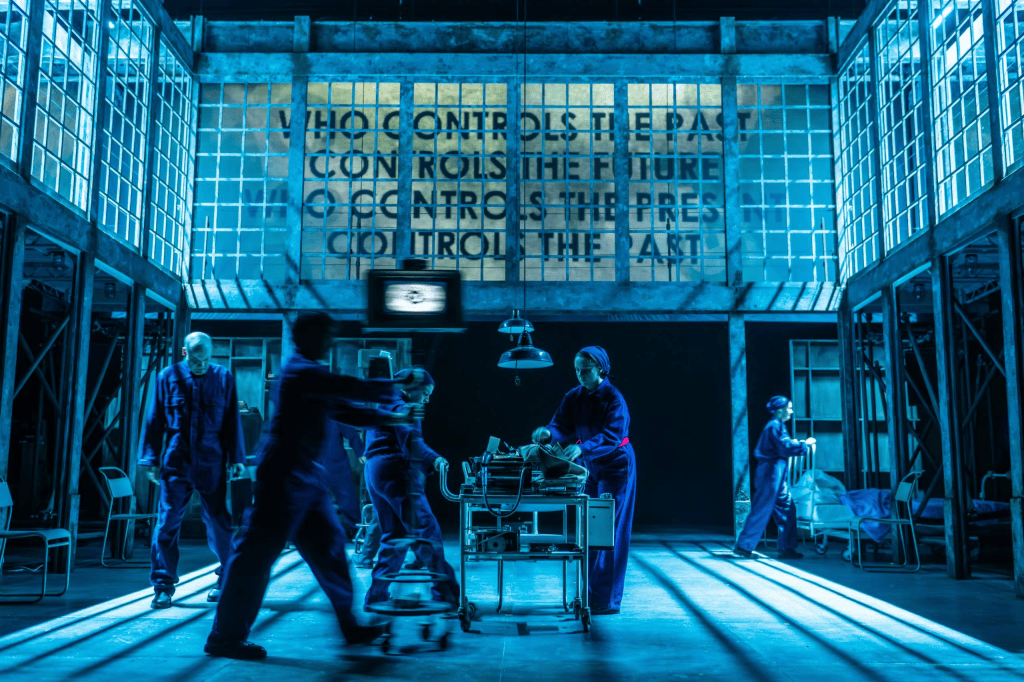
Photo: Citizen’s Theatre
Video design by Heather Scott, with programming by Grace Priest, is similarly effective and refreshingly restrained. The visual elements are well integrated without becoming distracting or overwhelming. With much of the torture in Act Two taking place behind gauze, there may be an opportunity to explore the use of video further in these scenes, deepening the audience’s understanding of Winston’s experience while maintaining the production’s bold visual statements.
It would be easy to dismiss this adaptation as a broad examination of familiar territory, but ultimately, it stands as a testament to the enduring power of Orwell’s source material. 1984 remains a cornerstone of modern literature, and translating its complex themes to the stage is no small feat. The cast work phenomenally well as an ensemble, bringing the novel’s many characters and ideas to life, even if they occasionally feel slightly overshadowed by the scale of the production around them.
There is plenty to admire here, from the strength of the performances to the inventive set design and atmospheric lighting. While some elements could benefit from further development, particularly in the relationship between movement, sound and characterisation, this is an ambitious production with much to offer.
It would be interesting to see this adaptation develop further, with storytelling and characterisation placed even more firmly at the forefront. A more intimate setting, coupled with a deeper exploration of movement and sound, could bring the audience closer to Winston’s experience and make the horrors of this world feel almost too close for comfort – in the best possible way. After all, the most unsettling thing about 1984 is not simply the world Orwell imagined, but how recognisable it begins to feel.
Chris Hannan’s 1984 runs at His Majesty’s Theatre until Saturday 17th November. Tickets available here: https://www.aberdeenperformingarts.com/whats-on/1984-2/
1984 will reach the final stop of its Scottish tour at the Royal Lyceum Theatre in Edinburgh next week. Tickets can be found here: https://lyceum.org.uk/events/1984
4 stars


Leave a Reply